




We’ve all heard the horror stories: general contractors who vanish mid-project, leaving behind unfinished work and a trail of headaches.
Maybe you saw it happen to a friend. Maybe you read about it in a local Facebook group. And maybe you thought, “That won’t happen to me. I’ve done my research.”
But here you are. Staring at your half-finished bathroom or torn-apart kitchen, wondering what on earth you’re supposed to do next.
If that’s you, breathe. You’re not alone. This is more common than most homeowners realize—and while it’s messy, it’s not impossible to move forward.
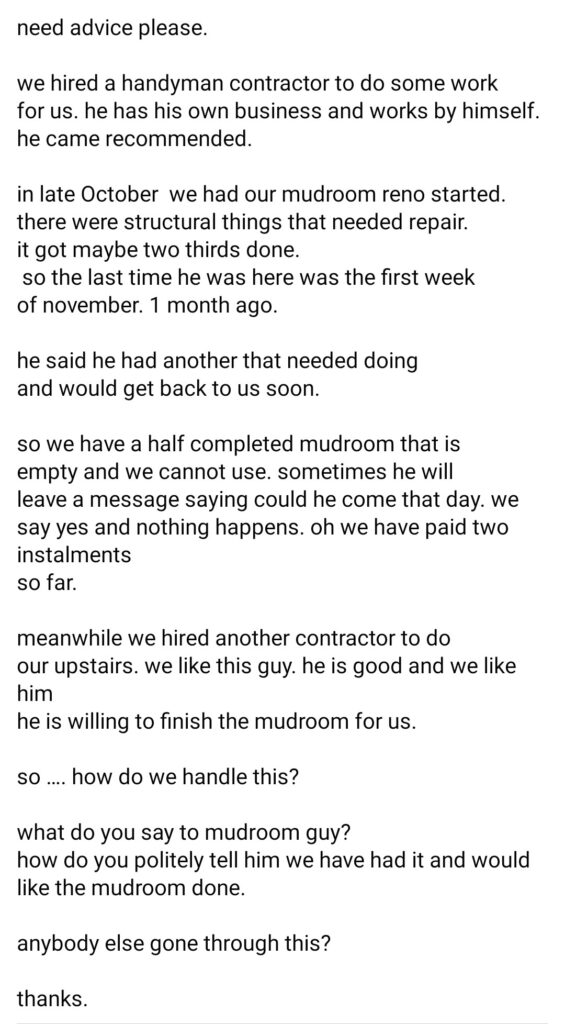
This week’s Design Files question came from a Facebook thread. Let’s call the homeowner Janet. She hired a highly recommended contractor for a mudroom renovation. Things started off well. But about a month into the project, the contractor mentioned he had another job to work on and would be back soon.
Spoiler: he didn’t come back.
Janet followed up with multiple text messages. She was polite, persistent, and kept trying to lock in a new date. A few responses trickled in, but no one ever showed up.
In the meantime, Janet hired a second contractor for a bathroom renovation. That project? A good job from start to finish. Clear communication. Showed up on time. Did what he said he’d do. She built a strong rapport with this second contractor and naturally wondered: can I just have him finish the mudroom, too?
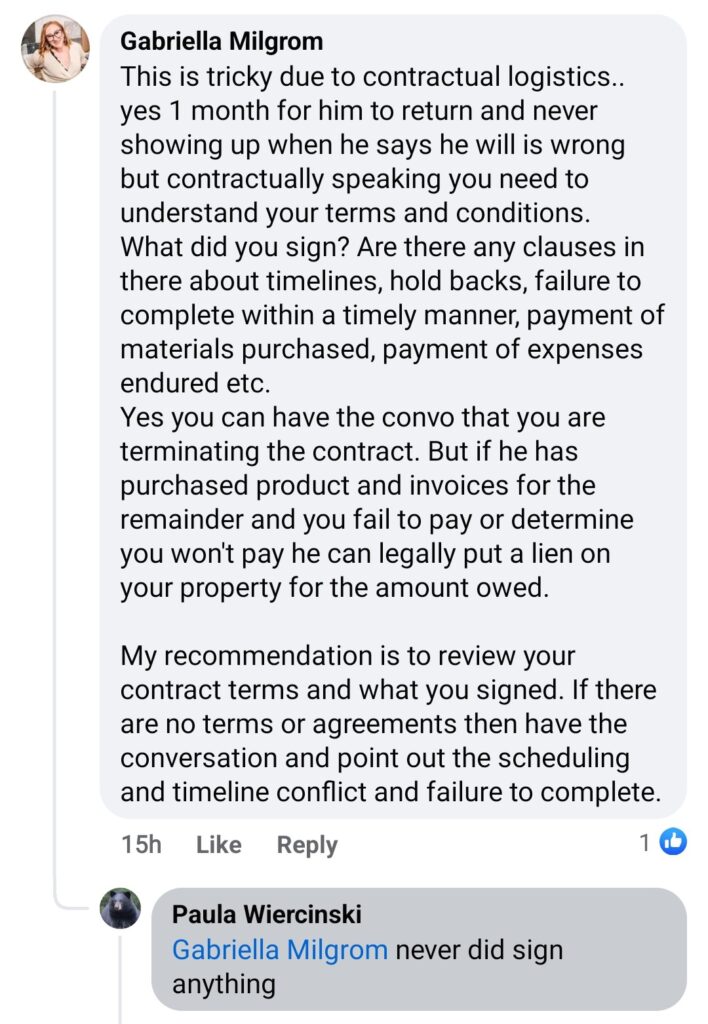
Here’s the challenge: about two-thirds of the mudroom was finished. Two installments had already been paid toward the total project costs. And the kicker? There was no written contract—just a quote and a verbal agreement.
So what now?
Let’s Talk About the Power of a Construction Contract
A construction contract is more than a formality. It’s your playbook, your proof, and your project guardrails all in one. It outlines the exact terms of the contract and every key detail of the agreement:
- The full scope of the project
- When payments are due and how much
- What happens if there are delays
- What counts as a delay outside the contractor’s control
- Any change orders and how they’re priced
- What a breach of contract claim looks like
- How legal action can be pursued if things go sideways
It’s what makes the difference between “he said/she said” and “here’s what we both signed.”
Without a signed initial contract, you’re left in limbo. One person believes they’re owed more money. The other feels abandoned. And there’s no clear document to reference.
Janet’s situation is unfortunately common: no original contract, no legal leverage. Which brings us to the big question…
What Are Your Options When the Original Agreement Falls Apart?
Let’s break this down.
Janet had a quote. She had text messages confirming the start of work, payments made, and follow-ups asking the contractor to return. But there was no official construction contract, and that makes this situation legally tricky.
Contractor #1 could argue:
- He completed a portion of the work and deserves payment
- There was no firm completion date in the original agreement
- Any delays were outside his control and not a breach
Janet could argue:
- A month of radio silence is not acceptable
- She’s been more than patient
- The verbal agreement was to complete the work in a timely manner
This, friends, is how contract disputes start.
With no documentation in place, it becomes a finger-pointing match. That’s why the very first step in contractor problems like this is to create a paper trail.

First Step: Build Your Paper Trail
You never want to be here, but if you are, you’ve got to protect yourself.
Start organizing every piece of proof you have:
- Screenshots of text messages
- Photos of the unfinished work (time-stamped)
- Copies of the quote
- Payment confirmations
- Any emails or contact information exchanged
Why? Because when emotions run high—and they will—your paper trail becomes the voice of reason. It shows what was promised, what was delivered, and where things fell apart.
Not only does this help if the issue escalates to arbitration services or legal action, but it also gives your next contractor clear context for the job ahead.
Second Step: Write a Demand Letter
Don’t skip this part. It’s easy to think “they’re not going to care,” but this isn’t about them. It’s about you creating clear documentation and giving the contractor one final chance to do the right thing.
What to include in your demand letter:
- A detailed description of the work completed (and not completed)
- The original scope of the project
- Total project costs, including what has already been paid
- Dates the contractor was supposed to show up but didn’t
- A firm date by which the work must be completed
- Access logistics (what days/times they can return)
Close the letter by stating clearly that if the work isn’t completed by the stated date, to your satisfaction, you will hire another contractor to finish the work—and no further payments will be made to contractor #1.
Attach your paper trail to the letter. Send it by email and certified mail, so you have record of delivery.
Even though you can’t use the small claims court system without a formal written contract, this still shows you made a good faith effort to resolve the issue. That matters—especially if a lien gets involved.
Third Step: Consider a Complaint with the Better Business Bureau or Licensing Board
If your contractor is a licensed contractor, this is a key path to explore.
File a formal complaint with the licensing board in your local jurisdiction. Losing a license is a big deal—and many general contractors will take swift action to avoid that outcome.
If the contractor isn’t licensed? (This is common, especially with small or unregistered contractors.)
Then your next best move is the Better Business Bureau. It won’t solve everything, but it creates a public record and puts pressure on the contractor to respond.
This is why it’s so important to ask upfront if your contractor is licensed and insured. Sure, a lower hourly rate from an unregistered contractor might look attractive… but it could cost you tenfold if things go wrong.
Fourth Step: Hire a Completion Contractor (With Caution)
Okay. So the deadline you gave in your demand letter has passed. No action. No communication. It’s time to move forward.
This is where you hire what’s known as a completion contractor—someone to finish the job.
But here’s what homeowners often overlook:
- To this new contractor, it’s not a continuation—it’s a brand new renovation project.
- They will need to inspect and verify the contractor’s work
- They might need to redo certain portions to meet their quality standards
- And yes, they’re now liable for the finished result
That means: ?? The quote to finish the job might be higher than what you expected.
Don’t rush this part. Do your due diligence. Check reviews. Call references. Ask clear questions. And above all?
Sign a written contract. Get every detail in writing this time around.
Fifth Step: Leave a Factual, Clear Review
After the dust settles, you might want to warn others. And that’s fair.
But a word of caution here: take the high road. Slander can backfire legally, and it doesn’t serve you.
Wait a few weeks. Gather your thoughts. Then:
- Stick to the facts your paper trail can back up
- Share the timeline, the communication gaps, and what work was incomplete
- Post it to community boards, BBB, Facebook groups, or contractor review sites
Other homeowners will benefit from your story—and your review will hold more weight if it’s clear, measured, and supported by evidence.
Final Thoughts (and a Bit of a Pep Talk)
You didn’t cause this. You were trying to get your home renovated. That doesn’t make you naive—it makes you human.
Renovation projects are stressful enough without contractor problems added to the mix. There are so many moving parts: budgets, schedules, materials, inspections. When your contractor walks off the job, it can feel overwhelming.
But you’re not stuck.
With the right documentation, the right support, and a new game plan, you can move forward. You can complete your home renovation and protect yourself from further damage.
If you’re still unsure what your best next step is, or want help reviewing your original agreement, I offer strategy calls for exactly this reason. We can talk through your contract (or lack thereof), assess risk, and get you back on solid ground.
? Book a strategy session here.
And if you want to make sure you never wind up in this situation again? Start with my post: 10 Questions to Ask Before Hiring a Contractor. It’s a must-read before any future home improvement projects.
You’ve got this. Let’s get your project back on track—without losing your mind (or your money) in the process.


Read the Comments +